
Golf Card Game: A Comprehensive Rules Guide
Gandalf, also known as Golf, is a strategic card game for 3-6 players. The goal is to achieve the lowest possible score over multiple rounds, utilizing skillful card swaps and calculated risks.
Golf, sometimes playfully called Gandalf, is a compelling card game rooted in strategic card exchange and a dash of luck. Originating from humble beginnings – reportedly taught in a Nepalese pub – this game has gained popularity through word-of-mouth, captivating players with its simple yet engaging mechanics. The core concept revolves around minimizing your card total across several rounds, making each decision crucial.
Unlike complex card games, Golf is remarkably accessible, easily learned by both seasoned card players and newcomers. It’s ideally suited for groups of 3 to 6 individuals, fostering social interaction and friendly competition. The game’s appeal lies in its blend of chance – the cards you draw – and skill – how you manage your hand and exploit opportunities to lower your score; This guide provides a comprehensive overview of the rules, strategies, and variations to elevate your Golf game.
Objective of the Game
The primary objective of Golf is to accumulate the lowest possible total card value over a predetermined number of rounds, or until a player reaches a specified elimination point total. Each player begins with four cards dealt face down, forming their “bench.” The values of these cards dictate your score, with Aces counting as 1 and face cards (Jack, Queen, King) valued at 11, 12, and 13 respectively. Jokers, if included in the deck, typically carry a hefty penalty of 14 points.
Success in Golf isn’t about collecting high-value cards; it’s about strategically reducing your total. Players achieve this by drawing cards from the deck and cleverly swapping them with cards on their bench, aiming for lower values. The game encourages calculated risks and astute observation of discards, as anticipating opponents’ needs can provide a significant advantage. Ultimately, the player with the lowest cumulative score at the game’s conclusion is declared the winner.
Players and Deck
Golf is ideally suited for a group of 3 to 6 players, though variations can accommodate slightly more. The game utilizes a standard 52-card deck, although incorporating Jokers is a common option, assigning them a value of 14. A single deck is sufficient for smaller player counts, but for larger groups, consider using two decks shuffled together to prevent the deck from depleting too quickly and requiring reshuffling mid-game.
Before commencing play, ensure the deck is thoroughly shuffled. Each player receives four cards dealt face down, arranged in a row in front of them – this constitutes their “bench.” One card is then drawn from the top of the deck and placed face-up to initiate the discard pile. This face-up card is available for potential swaps during gameplay. The remaining cards form the draw pile, from which players will draw throughout the game, seeking to improve their hand and lower their overall score.
Card Values
In Golf, card values are straightforward, directly impacting a player’s score. Numbered cards (2 through 10) retain their face value. The face cards – Jacks, Queens, and Kings – are assigned values of 11, 12, and 13 respectively. Aces are particularly valuable, holding a low value of 1, making them highly desirable cards to acquire during gameplay.
Should Jokers be included in the deck, they are typically assigned the highest value of 14, representing a significant penalty if held at the end of a round. The objective is to minimize your total card value, therefore, strategically swapping high-value cards for lower ones is crucial. Players must remember these values when evaluating potential swaps and making decisions on their turn, aiming to build a hand with the lowest possible cumulative score. Understanding these values is fundamental to successful play.
Dealing the Cards
To begin a game of Golf, each player is dealt four cards face down, arranged in a horizontal line in front of them. This line of face-down cards constitutes each player’s “bench.” The remaining cards form the draw deck, placed face down in the center of the playing area. To initiate the discard pile, a single card is drawn from the top of the draw deck and placed face up beside it.
This face-up card starts the discard pile, providing an immediate option for potential swaps later in the game. The dealer is typically determined randomly at the start of the first round, and the role rotates clockwise (or anticlockwise, as agreed upon) with each subsequent round. Proper dealing ensures all players have an equal starting hand, setting the stage for strategic card manipulation and a competitive game.
Initial Card Viewing
Following the deal, players are granted a limited opportunity to view their initial hand. Each player may secretly look at any two of their four face-down cards on their bench. This initial viewing is a crucial step, allowing players to begin assessing their potential score and formulating a basic strategy.
It’s important to remember this viewing is a one-time privilege; players cannot look at their cards again after this initial assessment. The information gained from these two cards will heavily influence their decisions during the gameplay phase, particularly when deciding whether to draw from the deck or attempt swaps. Strategic card selection during this phase can significantly impact a player’s overall score and chances of winning.
Gameplay: Your Turn Options
On your turn, you have three primary actions to choose from, each presenting unique strategic opportunities. The first option is to Draw from the Deck, taking the top card and immediately deciding how to utilize it. Secondly, you can initiate a Single Card Exchange, swapping the drawn card for one of your face-down bench cards – without looking at the bench card first!

Finally, a more complex option allows for Multiple Card Exchange. You can swap pairs, triplets, or even all four cards from your bench for a single card from the deck, aiming for a lower overall total. Remember, the goal is to minimize your score. Careful consideration of your current hand and the potential risks and rewards of each action is key to successful gameplay.

Option 1: Drawing from the Deck
Choosing to Draw from the Deck initiates a crucial phase of your turn. You take the top card from the face-down deck and, importantly, you are permitted to look at it privately. This allows for immediate assessment of its potential value within your current hand. However, drawing doesn’t commit you to keeping the card.
After viewing the drawn card, you must then decide whether to integrate it into your hand by swapping it with one of your face-down bench cards, or potentially utilize it in a multiple card exchange. This decision requires careful evaluation of your existing bench, considering the card values and the overall objective of achieving the lowest possible total. The drawn card presents an opportunity to improve your hand, but also carries the risk of worsening it.
Swapping Cards – Single Card Exchange
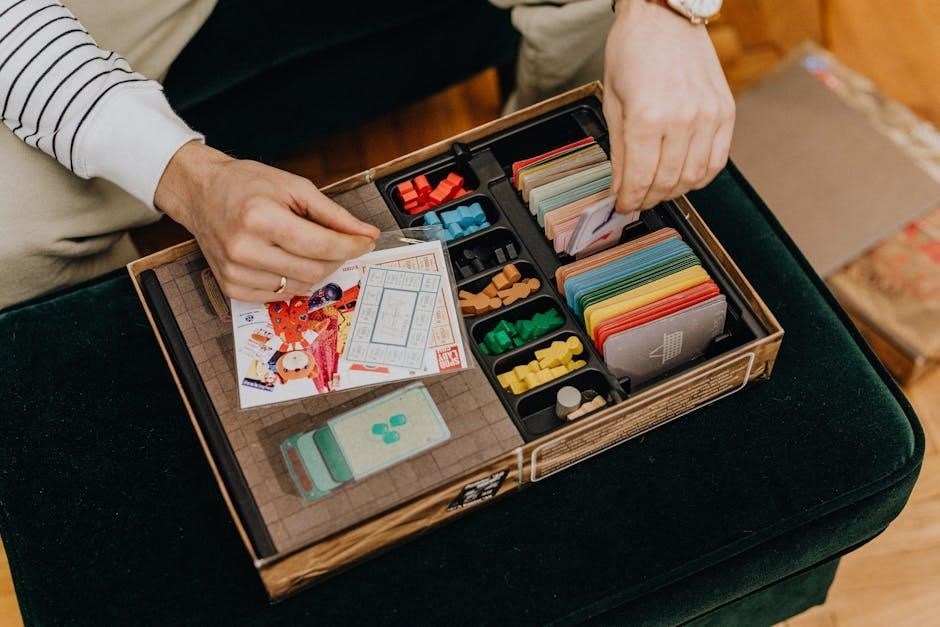
Following a draw from the deck, the Single Card Exchange allows you to replace one of your face-down bench cards with the newly drawn card. Critically, you perform this exchange without looking at the card you are discarding from your bench. This element of blind faith introduces a strategic gamble – you’re trusting your intuition about which card is likely hindering your score the most;
The drawn card immediately takes the place of the discarded bench card. This simple exchange can dramatically alter your hand’s potential. It’s a fundamental tactic for reducing your overall score, but requires careful consideration. Weigh the potential benefit of the new card against the unknown value of the one you’re relinquishing. Remember, minimizing your total is the ultimate goal!
Swapping Cards – Multiple Card Exchange
A more advanced tactic is the Multiple Card Exchange, allowing players to swap sets of cards from their bench – pairs, triplets, or even all four – for a single card drawn from the deck. This is a powerful maneuver, potentially reducing your card count and, consequently, your potential score significantly. For example, exchanging a pair of 6s for an 8 could be a game-changing decision.
However, this exchange also carries risk. You’re discarding multiple cards based on a collective assessment of their value, hoping the single drawn card will improve your overall hand. This strategy is best employed when you have a cluster of high-value cards or believe a single, low-value card will drastically lower your total. Careful evaluation is key to maximizing the benefits of this exchange.

The Discard Pile

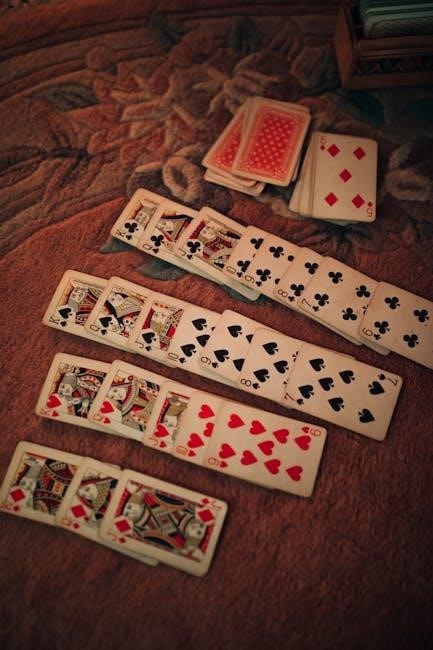
The Discard Pile is a crucial element of Gandalf (Golf). It begins with a single card dealt face-up from the deck at the start of the game, forming the initial offering for potential swaps. Throughout the game, cards discarded during exchanges – whether single cards or sets – are added to this pile, always remaining face-up for all players to see.
The Discard Pile provides valuable information about the cards already in play and can influence strategic decisions. Observing the discarded cards can help players deduce which values are less likely to appear when drawing from the deck. While you cannot retrieve cards from the Discard Pile, its contents offer a glimpse into the game’s evolving landscape, aiding in calculated risk-taking and informed card exchanges.
Restrictions on Card Viewing
A core rule of Gandalf (Golf) centers around limited information. Players are initially allowed a single viewing of only two of their four face-down cards dealt at the beginning of the game. This initial peek is a crucial opportunity to assess your starting hand and formulate a basic strategy.
However, a strict restriction applies throughout the rest of the game: players are never permitted to look at the cards on their own or any other player’s Bench (the line of face-down cards). This rule emphasizes memory, deduction, and calculated risk. Swapping cards is done blindly, relying on the information gleaned from the Discard Pile and an understanding of probabilities. Maintaining this restriction is vital for fair play and strategic depth.
Game Direction (Clockwise/Anticlockwise)
The flow of play in Gandalf (Golf) offers a choice to the group before the game begins, impacting strategic considerations. Players must collectively decide whether turns will proceed clockwise, starting from the left of the dealer, or anticlockwise, beginning from the right of the dealer.
This decision isn’t merely procedural; it influences how players anticipate opponents’ actions and adjust their own strategies. A clockwise direction might favor players who prefer a more predictable flow, while an anticlockwise direction could introduce an element of surprise. Regardless of the chosen direction, consistency is key throughout the entire game. Once established, the direction of play remains constant for all subsequent turns and rounds, ensuring a fair and orderly progression.
Scoring System: Lowest Total Wins
The core principle of Gandalf (Golf) revolves around minimizing your card total. At the end of each round, players calculate the sum of the values of the cards remaining in their ‘bench’ – their face-down lineup of cards. Aces are uniquely valued at 1, while number cards retain their face value. Face cards – Jacks, Queens, and Kings – carry values of 11, 12, and 13 respectively. Jokers, if included in the deck, are typically assigned a high value of 14, representing a significant penalty.
The player with the lowest total score for that round is the victor, earning a favorable outcome. However, the game rarely concludes after a single round. Instead, a cumulative point total is maintained, with round scores added to a running tally. This emphasizes consistent low scoring over multiple rounds to ultimately claim overall victory.
Penalty Points
Penalty points in Gandalf (Golf) are crucial for adding complexity and risk to the gameplay. These points are incurred under specific circumstances, primarily related to unsuccessful card swaps or ending a round with particularly high-value cards. While the core aim is to lower your total, strategic decisions can sometimes backfire, resulting in penalties added to your cumulative score.
For instance, if a player attempts a multiple card exchange (swapping a pair, triplet, or four cards) but the drawn card doesn’t improve their overall hand, a penalty might be applied. The exact penalty value is often predetermined before the game begins. Furthermore, holding a Joker at the round’s end typically incurs a substantial penalty, given its high assigned value of 14. These penalties encourage careful consideration before initiating swaps.
Round-End Points
Round-end points are calculated after each player has had their turn and no one wishes to draw or swap further cards. Each player reveals their entire ‘bench’ – the four cards dealt face down at the beginning of the round. The card values are then totaled, with Aces counting as 1 and face cards (Jack, Queen, King) as 11, 12, and 13 respectively. Jokers, if included, are typically worth 14.
The player with the lowest total for that round receives a predetermined number of points, often zero, while other players accumulate points based on the difference between their total and the lowest score. These points are added to their cumulative total. It’s important to note that penalty points, incurred during the round through unsuccessful swaps or holding high-value cards, are also added at this stage, contributing to the final round score.
Game End Conditions
The Game End Conditions in Golf are flexible, allowing players to tailor the experience to their preferences. Typically, the game concludes after a predetermined number of rounds have been completed. This number is agreed upon before the start of play, ensuring a consistent game length. Alternatively, the game can end when a player reaches a pre-set elimination total – a cumulative score signifying they are ‘out’ of the game.
Once the end condition is met, the player with the lowest cumulative score across all rounds is declared the winner. It’s common to play multiple ‘sittings’ of Golf, tracking scores across sessions for a grand champion. Variations exist where players are eliminated round-by-round until only one remains. The chosen end condition should be clearly communicated before the first card is dealt, preventing disputes and ensuring fair play.
Standalone Game Variations
Standalone Game Variations offer a streamlined Golf experience, ideal for shorter play sessions or when cumulative scoring isn’t desired. One popular variation involves playing a fixed number of rounds, with the lowest score within that session determining the winner, discarding any previous tallies. Another approach focuses on a single, decisive round – a quick test of skill and luck.
For a more challenging standalone game, implement a ‘highest score loses’ rule, adding pressure to every card swap. Players can also agree to a handicap system, adjusting starting scores based on skill level. These variations maintain the core mechanics of drawing, swapping, and minimizing card values, but remove the long-term scoring element. They’re perfect for casual play or introducing new players to the game’s fundamentals.

Scoreless Game Variations
Scoreless Game Variations shift the focus from numerical totals to strategic card manipulation and quick thinking. A compelling option is “First to Zero,” where the objective is to get all cards on your bench to a value of one (Aces) as quickly as possible. This encourages aggressive swapping and risk-taking. Another variation involves a “Lowest Card Wins” round – the player with the single lowest card on their bench at the end of a round is declared the winner, irrespective of overall totals.
Further, a “Blind Swap” variation adds an element of chance; players swap cards without looking at either their bench cards or the drawn card. These variations emphasize immediate tactical decisions over long-term scoring strategies, offering a different flavor of the Golf card game experience. They’re excellent for players who enjoy a faster-paced, less analytical style of play.
Terminology: Bench, Deck, Discard Pile
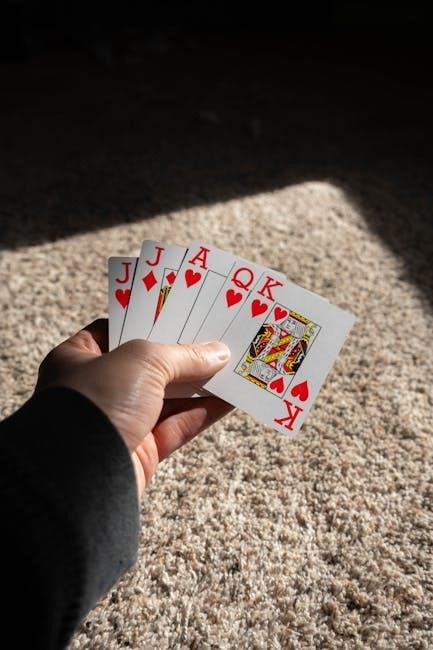
Understanding the core Golf terminology is crucial for seamless gameplay. The Bench refers to the four cards each player receives at the start, arranged face down in a line in front of them. These represent a player’s initial hand and are the focus of strategic swapping throughout the game. The Deck is the remaining stack of cards placed face down in the center of the playing area, serving as the source for drawing new cards during a player’s turn.
Finally, the Discard Pile is the face-up pile initiated with a single card from the deck at the game’s beginning. Cards discarded during swaps are added to this pile; Players are generally prohibited from viewing cards on any bench, including their own, unless explicitly permitted by a game rule. Mastering these terms ensures clear communication and a smoother, more enjoyable Golf experience.
Advanced Strategies
Beyond basic gameplay, mastering Golf involves nuanced strategies. Early game, prioritize revealing low-value cards on your Bench to minimize potential penalties. Consider the risk versus reward when swapping; a guaranteed low card is preferable to hoping for a better draw. Observe opponents’ discards – they offer clues about the cards they don’t need, potentially revealing information about their hand.
Strategic swapping of multiple cards (pairs, triplets, or quads) can dramatically lower your score, but requires careful assessment of the deck’s potential. Don’t be afraid to hold onto a slightly higher card if it prevents revealing a potentially disastrous one. Remember, cumulative scoring means consistently minimizing losses is as important as achieving low rounds. Adapt your strategy based on the number of players and the established elimination total, maximizing your chances of victory in this engaging card game;